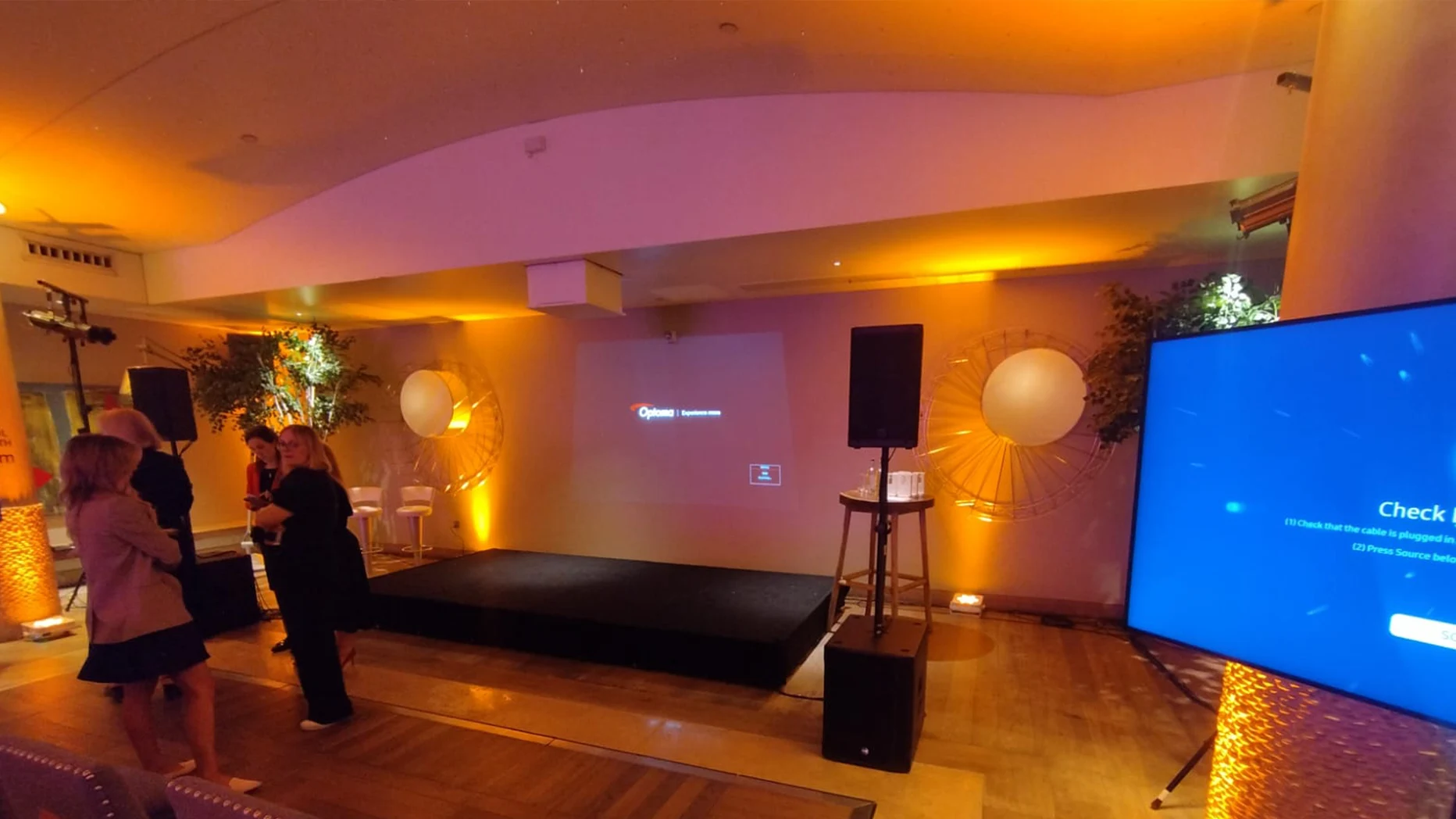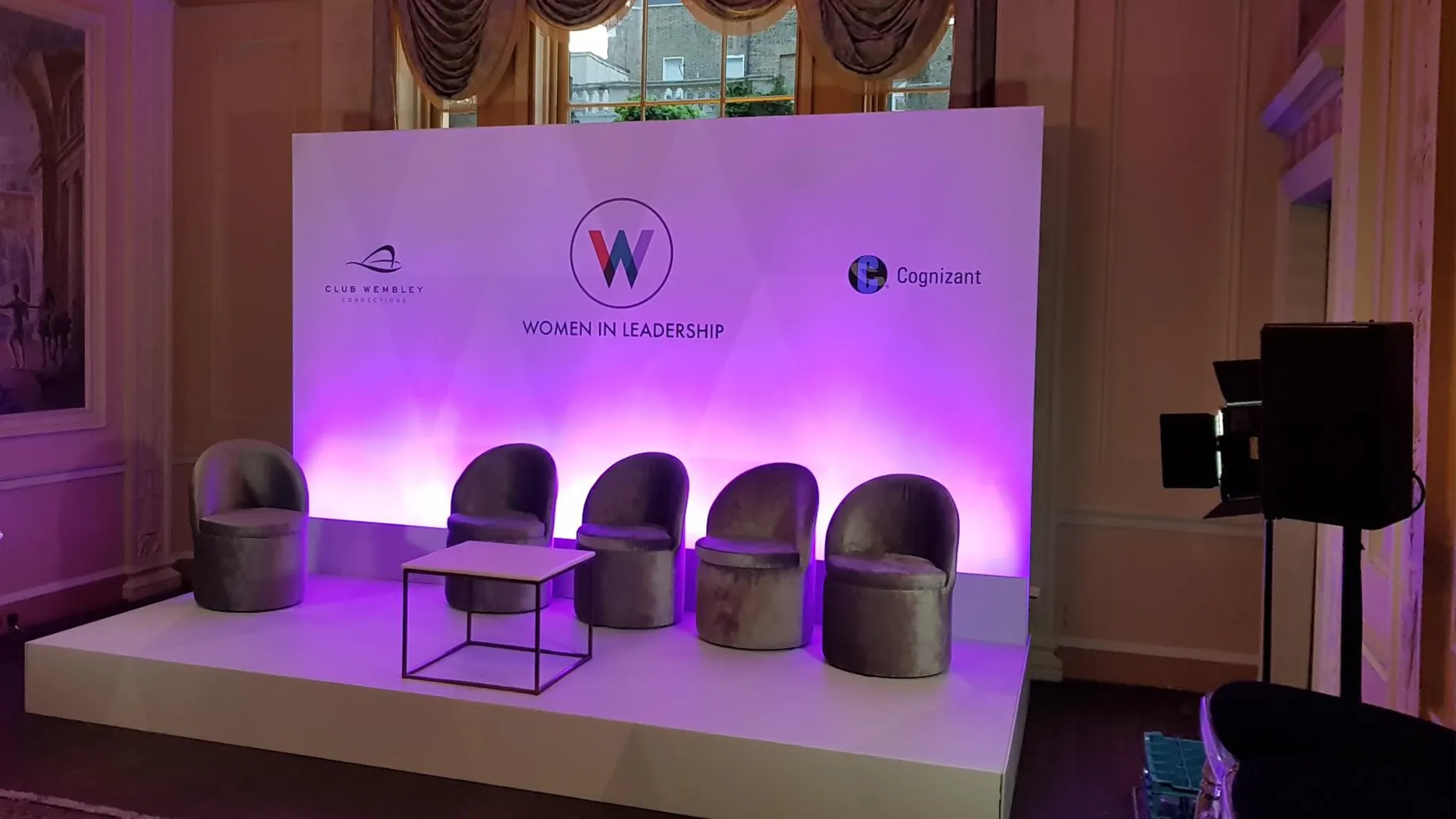
If you are planning a corporate conference, awards evening or product launch, the stage is one of the most consequential decisions in your production brief. Get it right, and your event feels authoritative, polished and well-managed from the first minute.
Get it wrong (wrong size, wrong height, wrong AV integration), and it creates problems that ripple through the entire day.
This guide covers what portable staging actually delivers, how to choose the right configuration for your event format, what the safety obligations are, and how to decide between hiring and buying.
What portable staging actually delivers at a corporate event
A stage does three things that matter to a corporate event planner.
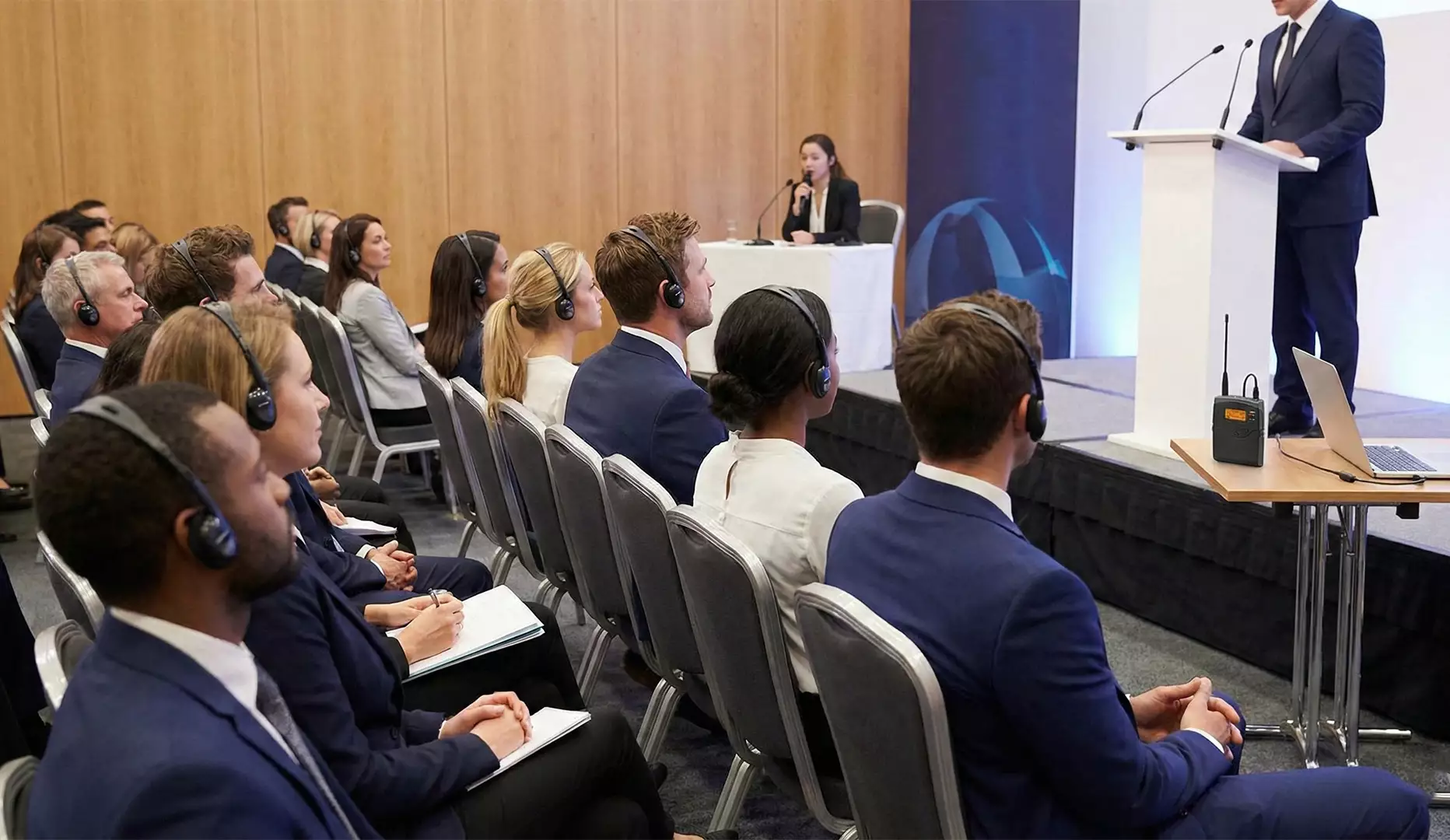
- First, it creates a focal point. In a hotel ballroom or conference suite, a speaker standing at floor level disappears behind the first few rows. Elevation brings the presenter into everyone’s sightline, which is the most direct way to improve audience engagement and attention throughout a long session.
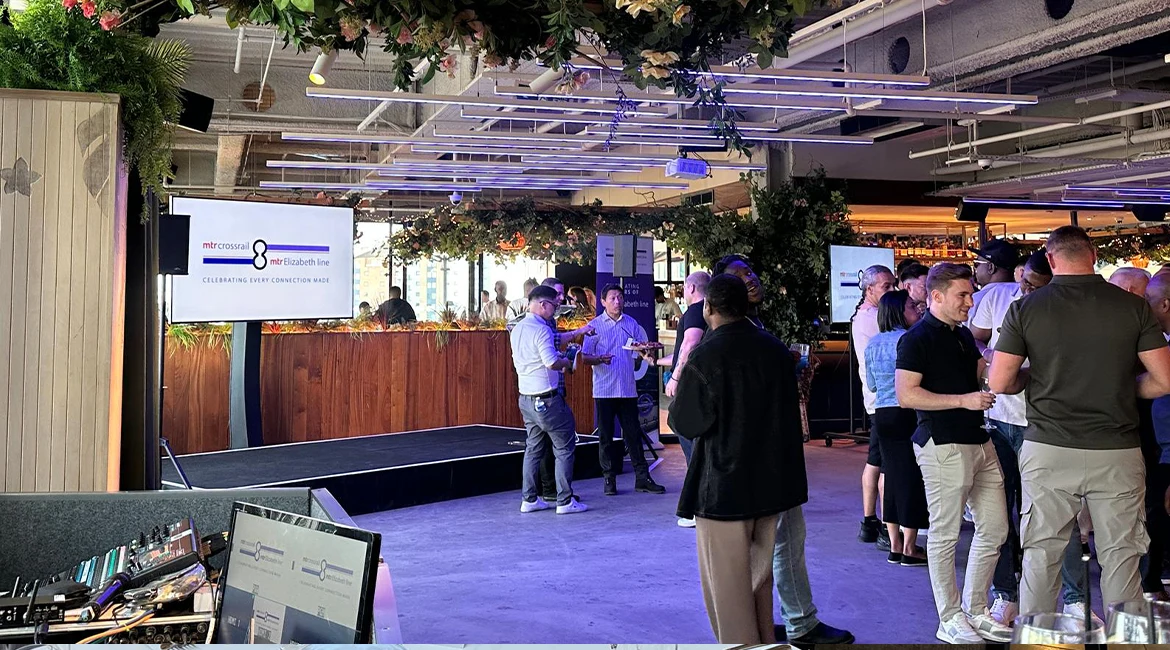
- Second, it signals production quality. Corporate audiences read the room before the agenda starts. A well-finished stage tells guests that the event has been professionally planned and managed. An absent or poorly chosen stage has the opposite effect.
- Third, it gives the event structure. In a full-day conference where the room hosts a morning keynote, an afternoon panel, and an evening awards ceremony, the stage defines where each session happens and helps the audience transition between formats. Without it, the day can feel improvised even when it has been meticulously planned.
Portable modular staging delivers all three, without permanent installation and without tying your layout to a fixed configuration.
Which events need a stage, and what each format requires
Not every event has the same staging requirements. The table below maps common corporate event formats to their key staging priorities:
| Event Type | Stage Priority | Key Staging Requirement |
| Keynote speech | High | Presenter movement space, lectern positioning |
| Panel discussion | High | Width for multiple speakers, mic management |
| Awards ceremony | Essential | Clear winner route, safe access and exit path |
| Product launch | High | Centrepiece visibility, branded fascia or backdrop |
| Training session | Medium | Low-profile platform, classroom sightlines |
| Conference (full day) | Essential | Modular config to suit multiple formats on the same day |
The common thread is that any event with a speaker, presenter or performer benefits from elevation and a defined platform. The configuration, width, depth, height, and access points change based on the format and the number of people on stage at any one time.
How to choose the right stage size and height?
Before picking any stage type for your events, look at the two main things mentioned below:
1. Size: Think format before dimensions
Stage size should be determined by what is happening on it, not by available floor space. The key questions are: how many people will be on stage at once, do they need to move or remain static, and is there a clear route on and off for entrances, exits and award walk-ups?
As a working reference:
- Solo keynote: 4m x 3m gives comfortable presenter movement plus a lectern.
- Panel of three to five: 6m x 3m minimum to accommodate chairs, side tables and mic stands without crowding.
- Awards ceremony: 6m x 4m or larger, with defined entry and exit paths and space for the presenter and recipient to stand together.
- Product launch: 5m x 4m, centred in the room with room for brand integration on the fascia and backdrop.
- Training session: 3m x 2.5m is often sufficient for a low-profile, classroom-appropriate platform.
These are planning ideas, not fixed specifications. Your staging supplier should sense-check dimensions against your actual venue before confirming the configuration.
2. Height: Balancing visibility with safety
The right height is the lowest elevation that puts the presenter in a clear sightline from the furthest seat in the room. A 200mm riser works in a 30-person training room. A 500 to 600mm platform is more appropriate in a 300-seat conference hall. Going higher than necessary creates access and safety obligations without adding meaningful visibility benefits.
Stage height also affects your AV layout. If screens are wall-mounted at a fixed height, the stage platform and screen positions need to be designed together. Too much height can force the audience to split attention between a low stage and high screens; too little height means the presenter is blocked by the front rows before slides are even visible.
| Key planning tip: Always design stage height alongside your screen positions and lighting rig, not in isolation. A staging supplier who also handles AV will catch these conflicts before build day, not during it. |
Stage Finish: What Separates a Platform from a Stage
The finish of your stage is what the audience actually sees. Corporate audiences notice the difference between a raw platform and a production-quality stage, even if they cannot articulate exactly why.
The finish elements that matter most for corporate events:
- Stage skirting conceals the legs, cable runs and flightcases beneath the platform. Without it, the underside of a modular stage is visible from the front rows and reads as unfinished.
- Steps should be wide and stable, positioned on the correct side for your run-of-show. Consider which side the MC enters from, and wherethe award winners will exit; these are different access points.
- Branded fascia panels on the front of the stage support product launches and award ceremonies where sponsor or brand visibility is part of the brief.
- Non-slip deck finish reduces noise from presenter movement and is a standard safety requirement on any professional hire.
Finish decisions should be confirmed at the quoting stage, not on the day. Last-minute additions like skirting or step upgrades can affect build time and may not always be possible with late notice.
AV Integration: sound, lighting and screens
A portable stage rarely works in isolation. It lives alongside your sound system, lighting rig and presentation screens, and the most common on-the-day problems happen at the joins between them.
- Audio
Lectern mics, lapel mics and handheld mics behave differently in a live room and need different gain settings. Panel sessions with multiple speakers require careful channel management. Any cabling from the stage to the desk needs to be routed and secured to eliminate trip hazards. This needs to be planned in the staging brief, not resolved on the morning of the event.
- Lighting
A front wash that covers the stage clearly is the single most impactful lighting addition for corporate events. It improves speaker visibility, makes photography usable and helps the audience stay focused during long sessions. For awards ceremonies and product launches, additional colour and gobo work support the tone and brand identity of the event.
- Screens and content display
Screen height should be designed relative to stage height. The base of the screen should sit above the top of the platform so the audience is not reading slides through the presenter. In venues with a low ceiling grid, this creates a constraint that affects both screen position and how high the stage can go, another reason to keep staging and AV in one brief rather than two.
| Why integrated production matters? When staging and AV are quoted and built by the same team, every element is designed to work together. Screen height references stage height. Mic cable routes are pre-planned. Lighting positions are confirmed before building. This approach eliminates the most common sources of live event problems. |
Stage safety and UK compliance requirements
UK health and safety guidance, including HSE guidance on temporary demountable structures and the Event Safety Guide (the Purple Guide), places clear obligations on event organisers to ensure stages are properly specified, erected and used by competent persons.
For corporate event planners, the practical implications are:
- Steps and handrails are required at any height where access is needed; this is not optional for stages over a certain elevation.
- Edge protection must clearly define the stage perimeter to prevent falls.
- Cable management must eliminate trip hazards at all access points and across the stage surface.
- Load capacity must be confirmed for the number of on-stage participants and any equipment such as lecterns, monitors or award tables.
- The build must be completed by a competent team that can confirm the structure is safe for use before rehearsal.
Professional stage hire includes all of this as standard. The risk arises when event teams source platforms independently, from general hire companies or online suppliers, without AV and safety integration, and then take on the compliance responsibility themselves without the competency to discharge it.
Portable stage hire vs buying: A direct comparison
Buying a stage looks cost-effective until you account for the full cost of ownership over time. The comparison below covers the factors that matter most for corporate event teams:
| Factor | Hiring a Stage | Buying a Stage |
| Upfront cost | Low, pay per event | High, significant capital outlay |
| Storage | None required | Ongoing warehouse space needed |
| Flexibility | Any size, finish or config per event | Fixed to the purchased system |
| Maintenance | Handled by the supplier | Your team’s responsibility |
| Safety compliance | Included with professional hire | Your responsibility is to confirm |
| Staff requirement | Crew provided | In-house resource needed |
| Best for | Teams running varied events | Fixed-venue, very high-frequency use |
For most corporate event teams running varied formats across different venues throughout the year, hire is the more practical and cost-effective model. Ownership only makes financial sense for organisations with a dedicated in-house production team, fixed-venue events at very high frequency, and the storage and maintenance infrastructure to support it.
Plan your corporate event stage with AV Productions
AV Productions has delivered portable stage hire for corporate conferences, awards ceremonies, product launches and training events across the UK for over 25 years. Our a pproach is production-led: staging is designed alongside your sound, lighting and screen setup from the outset so that every element works together on the day.
We quote within 24 hours for most briefs and confirm all access, crew and technical requirements before build day, so there are no surprises on the morning of your event.
To receive an accurate quote, share the following:
Event date and venue
- Audience size and room layout.
- Event format (keynote, panel, awards, product launch, training)
- Stage size and height preference, if known.
- AV requirements: microphones, speakers, screens, and lighting.
Contact AV Productions to discuss your event →
FAQs
How far in advance should I book portable stage hire?
For events in the busy UK conference season, September through November and January through March, booking six to eight weeks in advance is advisable for mid-size builds. Larger productions with significant AV integration may need a longer lead time to confirm crew availability and equipment. Many suppliers can accommodate shorter notice for simpler builds, but late bookings increase the risk that preferred suppliers are already committed.
Do I need handrails on a portable stage?
UK guidance requires that stage access, steps and any elevated platform include appropriate edge protection and handrails where the height creates a fall risk. The specific requirement depends on height and usage. A professional staging supplier will advise on what is required for your build height and confirm compliance as part of the hire. Do not assume handrails are optional on any stage above a low riser height.
Can a portable stage be reconfigured between sessions on the same day?
Yes. This is one of the primary advantages of modular staging. The platform can be extended, reduced or reconfigured between morning and afternoon sessions with the right crew and lead time. If your event runs multiple formats, a keynote in the morning and a panel or awards in the evening, share the full running order with your supplier when you brief the job. They can confirm whether one configuration covers all sessions or whether a changeover window is needed.
What information does a staging supplier need to provide an accurate quote?
To quote accurately, a supplier needs: your event date and venue name or location, audience size and room layout (theatre, cabaret, classroom), the event formats (keynote, panel, awards, product launch), preferred stage dimensions and height if known, and your AV requirements including microphones, speakers, screens and lighting. Venue access details, door widths, lift access, load-in window and crew parking are also useful to confirm before the quote is finalised.