When choosing a London event production partner, the biggest mistakes usually happen before the event begins. Poor briefing, late supplier engagement, and weak coordination between AV, staging, and on-site delivery can all lead to costly problems on the day.
That is why choosing the right event production company in London matters. For corporate events, conferences, product launches, and awards ceremonies, strong production planning keeps audio, lighting, staging, screens, and show flow working as one system. This guide explains the most common mistakes to avoid so you can compare suppliers properly, reduce risk, and deliver a smoother event.
Mistake 1: Engaging event production companies too late
The most common and most avoidable mistake is leaving the production brief too late.
For corporate events with meaningful AV and staging, 8–12 weeks is the professional standard for engaging a London event production company. Less than 4 weeks is the point at which avoidable problems quickly become almost guaranteed.
When you book late, every later stage is squeezed.
- The venue may not allow enough build time.
- Your preferred production company may not have its best crew available.
- The ideal equipment may already be allocated to another event.
- There is not enough time for a full technical rehearsal.
Why does this hit AV so hard?
LED video walls, bespoke staging, custom lighting rigs and hybrid streaming setups all need design time, pre-programming and pre-rigging. You cannot compress these without losing quality.
A production brief that lands six weeks before a large conference is not a six-week job.
The results of a late brief:
- Equipment substitutions because the preferred kit is unavailable.
- Reduced or no rehearsal time.
- Crew who are less familiar with your specific brief.
- A technical build that starts on the morning of the event instead of the night before.
Each of these increases the chance of on-the-day failure.
Mistake 2: Approaching suppliers without a clear brief
Speaking to an event production company in London without a clear brief almost always leads to the same outcome: a vague quote that you cannot compare and that doesn’t match what you actually need.
What a useful brief should include
For a corporate event, your brief should cover:
- Event date
- Venue name (or shortlist)
- Audience size
- Room layout
- Event format and outline run-of-show
- Known technical (AV) requirements
- Branding or creative requirements
- Budget range
- Decision timeline
Without these basics, you are asking for a quote on a hypothetical event, not your real one.
AV impact of a weak brief
With little information, the production company cannot:
- Specify the right PA system for the room.
- Decide between projection and LED for your light conditions.
- Design a lighting rig that fits your format.
The quote will either:
- Over-specify (and cost more than needed), or
- Under-specify (and deliver less than required).
Neither is helpful.
Minimum brief checklist: Event date | Venue name or shortlist | Audience size | Room layout | Event format (keynote, panel, awards, hybrid) | Known AV needs | Budget range | Decision date
Mistake 3: Choosing the cheapest quote without understanding the scope
The lowest-priced quote is almost never the lowest total cost. Often, a cheap quote leaves out key items that will:
- Reappear later as “extras”, or
- Simply be missing on the day.
Common examples:
- No backup microphones or spare equipment.
- Only one technician for a complex event.
- No de-rig labour included.
- No project management time.
- Minimal or unsafe cable management.
Why is this risky for AV
A quote that excludes backup microphones, a redundant media server, or a second camera operator is not a cheaper version of the same service. It is a different, more fragile setup that may fail under stress.
The simple test
Ask every production company for an itemised quote that separates:
- Equipment hire.
- Crew.
- Delivery and logistics.
- Build and de-rig.
- Project management fees.
Only then can you compare like for like.
The real cost of “cheap”
A failed PA at a 200-person conference, a lighting rig that cannot execute your big reveal, or a live stream that drops mid-session does more than inconvenience guests. It damages your brand and the perceived professionalism of your organisation.
The cost of fixing or carrying that damage almost always exceeds the small savings that drove the original decision.
Mistake 4: Not checking experience with your type of event
London event production companies cover many formats:
- Music festivals.
- Experiential activations.
- Trade shows.
- Corporate conferences.
- Awards ceremonies.
- Product launches.
- Hybrid events.
- Training days.
Each demands a different mix of technical skills, finish level and operational discipline.
A company with a strong festival portfolio is not automatically the right choice for a corporate conference. The details differ:
- Cable management and stage skirting.
- Presenter confidence monitoring.
- Managing multiple microphones for panels.
- Tone, timing and communication with presenters.
AV skills don’t always transfer
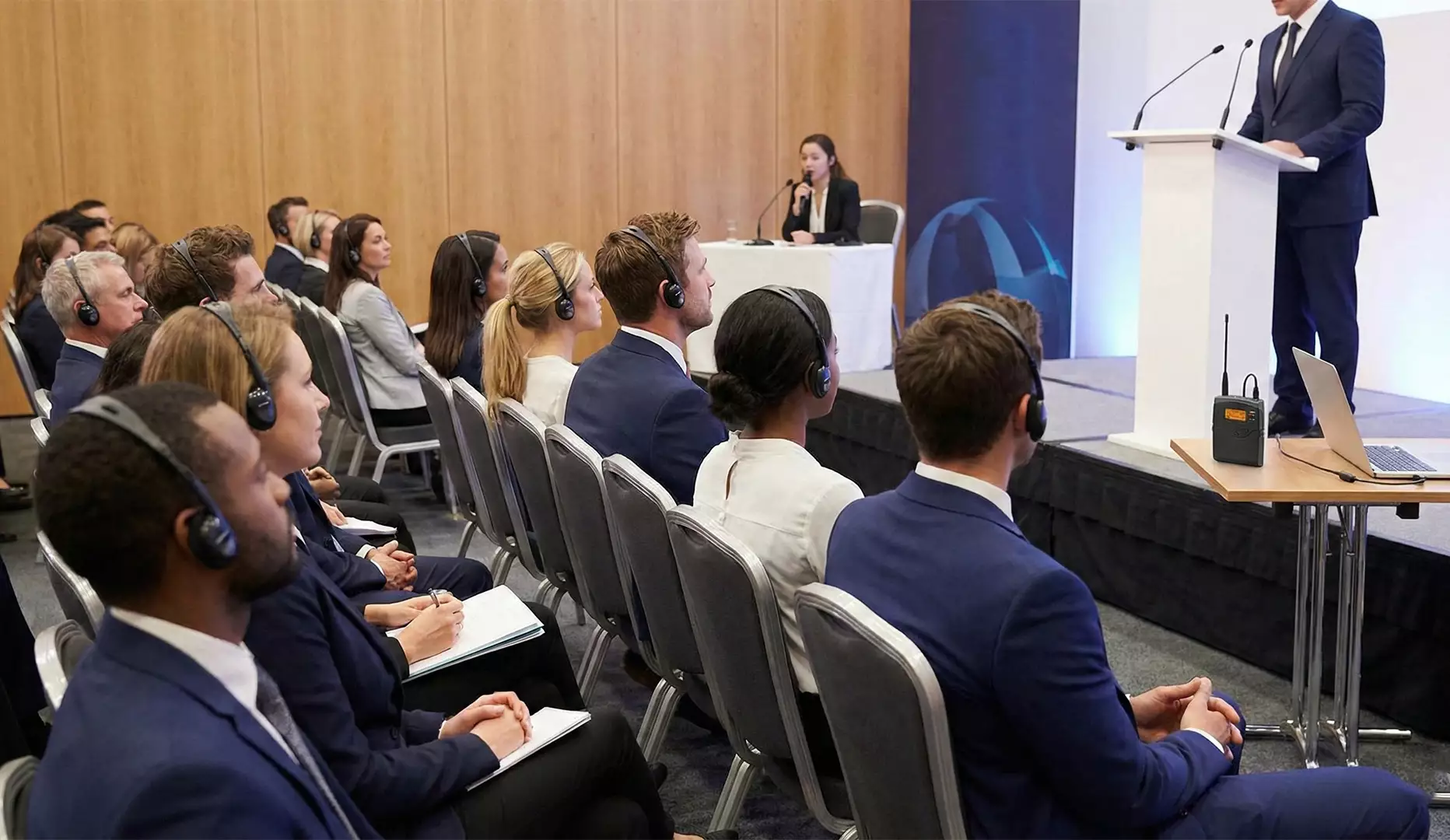
Corporate audio needs careful gain management over a full working day with different presenter types. Corporate staging needs a clean, brand-reflective finish, not the energy of a concert.
These are skills learned from experience in that format.
Key question: “Can you share two or three case studies from corporate events specifically, at a similar audience size to mine?”
Mistake 5: Splitting the staging and av briefs
This is one of the most damaging structural mistakes: commissioning staging from one supplier and AV from another.
It creates an integration gap.
All of these are linked:
- Stage height → screen position.
- Screen position → viewing angles.
- Viewing angles → where speakers can be placed.
- Speaker positions → how the stage can be lit.
- Lighting positions → what is visible in photos and video.
These are not separate decisions. They are one technical system.
When one team controls all of them, the system is designed properly. When multiple suppliers control different pieces, no one owns the whole picture.
What goes wrong on the day
Integration issues usually appear during the build, not at the planning stage:
- A screen blocks the lighting rig.
- A cable route creates a trip hazard on the steps.
- A PA hang clashes with scenic elements or branding.
At that point, with an hour before guests arrive, fixes are:
- Stressful.
- Expensive.
- Sometimes impossible to fully resolve.
End result: Compromised sightlines, visual clutter, uneven audio coverage, or a stage layout that can’t deliver your planned reveal or awards moment. These are not accidents; they’re the predictable result of a split brief.
Mistake 6: Assuming all production companies use the same equipment
What an event production company shows in marketing and what they actually deploy on the day can be very different.
Some companies:
- Own their key inventory.
- Maintain it carefully.
- Know its performance in detail.
Others:
- Sub-hire most of their equipment.
- Have less control over the condition and compatibility.
Why this matters for AV
Problems often only appear under real conditions:
- A PA system that looks right on paper but distorts under sustained load.
- An LED wall built from mixed panel batches, showing colour variation.
- A live stream using a weak internet infrastructure that fails under peak traffic.
Questions to ask
- “Which parts of your standard corporate package do you own?”
- “What do you sub-hire, and from whom?”
- “Can I visit your warehouse and see the kit before I confirm?”
A company with strong in-house inventory will answer these confidently and welcome a visit. A company that sub-hires most things usually cannot.
Mistake 7: Not asking what happens when something goes wrong
Every experienced London event production company has handled:
- Equipment failures.
- Access delays.
- Presenter cancellations.
- Venue Wi-Fi issues.
- Weather-related logistics problems.
The question is not if these happen, but how your supplier plans for them.
What a professional contingency plan looks like
Strong companies will:
- Bring backup equipment as standard.
- Use redundant media servers and backup signal paths for critical content.
- Carry spare microphones.
- Have a second technical lead for complex events.
- Use a clear escalation process for different failure types.
- Rehearse contingencies during the technical rehearsal.
Extra focus for hybrid events
For hybrid or streamed events, ask specifically about:
- Streaming contingency.
- Redundant connectivity.
- Backup encoders.
- Live monitoring during the event.
This shows whether their contingency plans are real or just words.
Question to ask: “Walk me through your contingency plan if the primary PA system fails twenty minutes before the event starts. What backup equipment do you bring, and who is responsible for switching over?”
Mistake 8: Overlooking communication and project management
Most on-the-day failures are not technical. They are communication failures from earlier weeks:
- A presenter change that no one told the AV team about.
- A run-of-show is never shared with technicians.
- A venue access rule was not sent to the crew.
- A brand asset was supplied in the wrong format two hours before doors open.
What good project management includes
A professional event production company in London should:
- Assign a named project manager.
- Share a planning timeline from brief to de-rig.
- Issue a technical specification for approval.
- Hold a production meeting with all technical leads 2–3 weeks before the event.
- Circulate a final run-of-show at least 48 hours before the event.
- Run a technical rehearsal before guests arrive.
AV details that must be managed
- Technical cue sheets.
- Presenter briefing notes.
- Content format guidelines.
- Live streaming configuration.
When these are managed as a process, problems surface before the event. When they are handled ad hoc, they surface during the event.
Mistake 9: Skipping the technical rehearsal
A technical rehearsal is not optional for any corporate event with serious production.
Without rehearsal, you are effectively debugging in front of your audience.
What the AV rehearsal should cover
- Every microphone type and gain setting in the live room.
- All video cues triggered in the right order.
- Confidence monitors showing the correct content.
- Lighting states for each section of the run-of-show.
- Reveal sequences timed and executed exactly as planned.
Each of these is a potential failure point. A rehearsal turns them into confirmed successes.
Event production companies that:
- Discourage rehearsal.
- Treat it as an add-on.
- Don’t build it into the schedule.
are telling you something important about their approach to quality.
The hidden cost of skipping rehearsal
- Presenters are visibly less confident.
- Technical issues that would take minutes to fix in rehearsal can take four times as long under live pressure.
- Lighting and AV cues rarely execute cleanly on the first attempt if they’ve never been run in sequence in the room.
The hour you “save” by skipping rehearsal often becomes three hours of stress on the day.
Mistake 10: Treating the event as the end, not the beginning
If your event delivers:
- No useful footage.
- No press photography.
- No post-event content.
- No structured lead capture.
…then it has only delivered value to people physically in the room.
For most corporate events, product launches, conferences and awards ceremonies, the post-event content is just as valuable as the live experience.
Plan content before the event
Agree in advance:
- What will be captured, and how.
- Who is responsible for filming and photography?
- What format assets will be delivered in?
- Who edits the highlight reel, and when will it be ready?
- What photography is needed for press and social media?
- Whether a full recording will be made for on-demand viewing.
These are production questions and need AV answers in the brief, not after the event.
Camera spec shapes your options
- A single static camera cannot produce a strong highlight reel.
- A multi-camera setup with a vision mixer and direct audio feed from the desk can deliver broadcast-quality content quickly, often on the same day.
The cost difference is often modest. The difference in commercial value after the event is significant.
Mistake 11: Not speaking to previous clients
Case studies and testimonials on a company website are marketing, not a complete picture.
They will not tell you:
- What happened when something went wrong?
- How did the team communicate under pressure?
- Whether the delivery matched the promises.
How to get a real view
Ask for two or three references from corporate clients who’ve run similar events.
When you speak to them, ask:
- What went wrong in planning or on the day, and how was it handled?
- Did the technical production deliver what was promised?
- Were the screens bright enough?
- Did the audio cover the room without feedback?
- Did the live stream stay up?
- Was the lighting actually operated or left static?
- Would you use this company again for a similar event?
The answers, especially to the last question, tell you more than any polished case study.
Work with a London event production company that gets it right
Every mistake in this guide is avoidable. The pattern is clear: problems that appear on the day usually come from decisions made weeks earlier.
The right production partner reduces these risks through:
- A structured briefing process.
- Integrated design across staging, AV, lighting, and content.
- Professional project management.
- A non-negotiable commitment to rehearsal.
AV Productions is a London-based event production company with over 25 years of experience delivering corporate conferences, product launches, awards ceremonies and hybrid events.
We offer:
- Integrated production: one team for staging, AV, lighting and content.
- A named project manager for every event.
- Owned and maintained in-house equipment.
- Itemised pricing for clear comparison.
- Full on-site crew from build to de-rig.
To receive a detailed production response within 48 hours, share:
- Event date and venue.
- Audience size and room layout.
- Event format and key moments in the run-of-show.
- Known technical or AV requirements.
- Budget range and decision timeline.
Contact AV Productions to discuss your event details.
Frequently Asked Questions
How early should I book an event production company?
For mid-size corporate events with significant AV and staging, plan to engage a supplier 8–12 weeks before the event date. Larger or more complex events, multi-room conferences, hybrid formats and bespoke sets may require 12–16 weeks. Anything less than 6 weeks increases risks around crew availability, equipment, rehearsal time and venue access.
What should my brief include to get accurate quotes?
Include at minimum:
- Event date and venue.
- Audience size and room layout.
- Event format and outline run-of-show.
- Known technical requirements.
- Branding or creative needs.
- Budget range.
- Decision timeline.
Without a budget, suppliers cannot propose realistic options. Without a venue, they cannot assess technical limits. The clearer the brief, the more useful and comparable the quotes.
Why are some event production quotes so much lower than others?
Usually because the scope is smaller, not because you are getting the same service for less. Cheap quotes often leave out backup equipment, extra technicians, de-rig labour, project management and proper cable management. Always ask for an itemised breakdown of equipment, crew, logistics, build, de-rig and project management so you can compare like for like.
Is a technical rehearsal really necessary?
Yes. For any event with meaningful AV, a technical rehearsal is the only way to confirm microphone levels, video cues, lighting states, confidence monitor content and the full run-of-show sequence in the actual room before guests arrive. Events that skip rehearsal almost always face issues on the day that could have been resolved in minutes the night before.