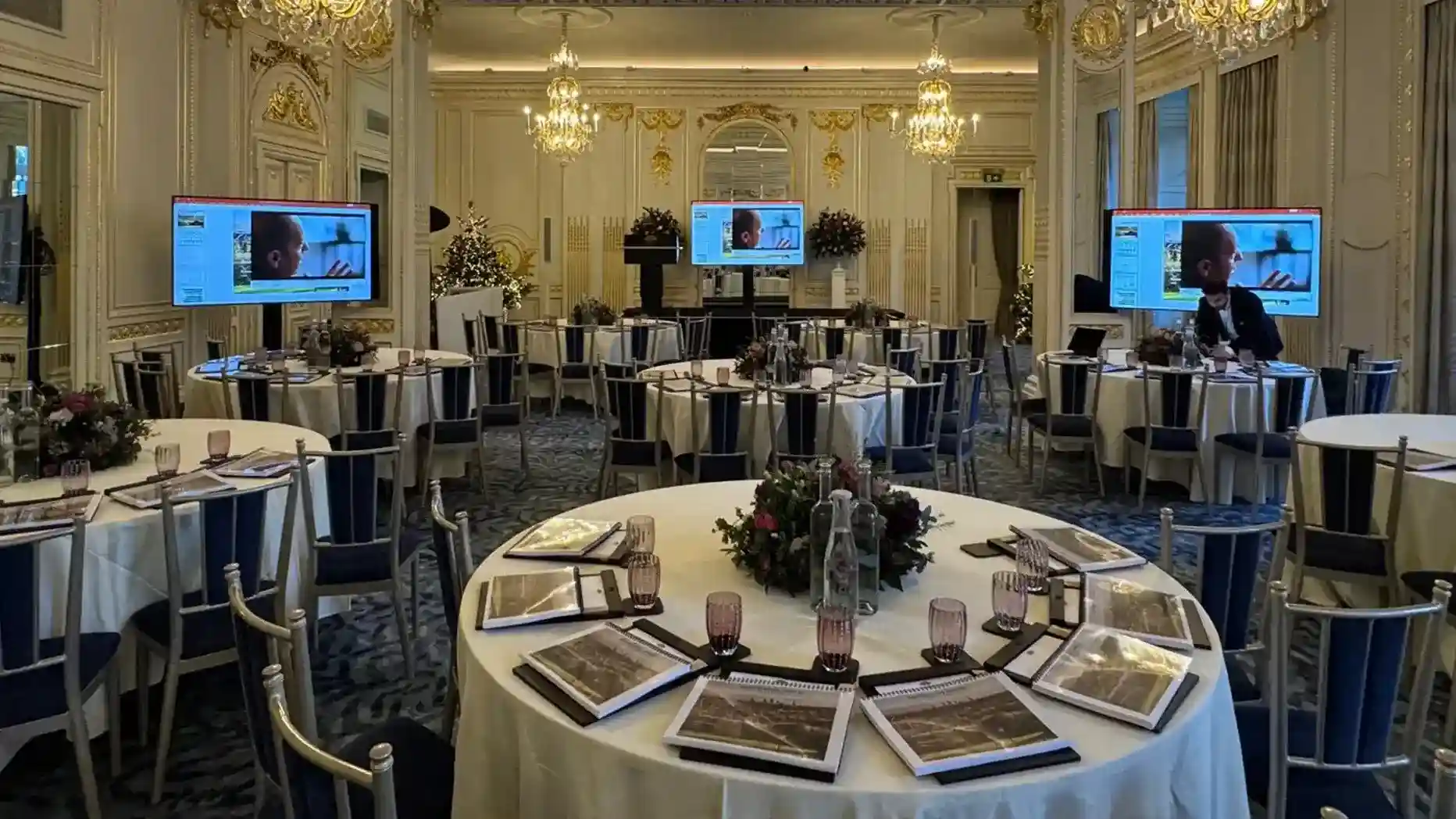
If you’re planning a conference, AGM, awards night or launch in London or across the UK, you need an AV friendly venue in London that works for sound, lighting, screens and streaming as well as guests. Start with your event format, then check access for kit, power, rigging limits, acoustics, sightlines and connectivity before you sign. Involve your AV partner early so they can review floorplans, spot technical red flags and help you pick a venue that supports the show you actually want to run.
You find a space that looks stunning in the photos. High ceilings, big windows, stylish bar. Then your AV team visits and says:
- “We can’t hang lights from that ceiling.”
- “There isn’t enough power for the LED wall.”
- “Sound will bounce everywhere in here.”
That’s the moment most planners decide they never want to repeat.
This guide walks you through what to check, so you can shortlist venues that actually work for your AV and production plan.
Why do AV-friendly venues matter in London?
AV is what turns a bare room into a live experience. Good sound, clear visuals and confident lighting are linked to:
- How well people can follow your content.
- How confident your speakers feel on stage.
- How professional your brand looks on screen and in photos.
If the venue can’t support your AV setup, you risk:
- Last-minute extra kit and crew.
- Extended build and de-rig hours.
- Awkward sightlines and messy layouts.
- Noise or power issues that annoy guests or neighbours.
In a busy city like London, where access, noise and working hours are tightly controlled, fixing those problems late can be costly.
Why should you start with your run-of-show and AV plan?
Before you even look at a floor plan, get clear on what needs to happen in the room. That means writing a simple run-of-show and sketching the AV:
You might have a morning of keynotes, an afternoon panel, and then awards in the evening. There may be a CEO at a lectern, a panel on stools, remote contributors dialling in, videos with sound, and live Q&A from the floor. You may want the whole thing recorded or streamed to remote offices across the UK and Europe.
Once this is on paper, an AV partner like AV Productions can translate it into the building’s structure:
- How big should the stage be, and where does it work best?
- What size screens will give good visibility, and whether you need side screens.
- Roughly how much power the kit will draw, and what type of power is sensible.
- Where cameras, operators and control positions need to sit.
- What sort of internet connection is required for the stream?
Now, when you walk into a room, you’re not asking, “Is it okay for AV?” You’re asking, “Can this building support this exact show?”
How do you look at a location through an AV lens?
You’ll already be thinking about transport links, hotels and accessibility. For an AV-friendly venue in London, you need a second pass that focuses on technical realities.
Central London hotels and city venues often live on tight plots with shared service yards. A loading bay might be on a narrow one-way street with strict time windows. Everything might have to come through a goods lift that’s just big enough for a small flightcase, or through public areas that only open after 7 am. That affects build time, crew numbers and cost.
Noise and licensing are another hidden constraint. If you want amplified sound late at night, or you’re using a space that doesn’t usually host entertainment, you may need a Temporary Event Notice under UK licensing law. Local councils can also impose strict noise limits and curfews, which will shape what you can realistically do with bands, DJs and awards walk-ups, especially in dense boroughs like Westminster or the City.
Listed status matters too. A heritage venue near a mainline station might be perfect for travel, but if it’s Grade II listed, you may not be allowed to attach anything to the walls or ceiling. That drives whether you can fly truss and speakers or whether everything has to be ground-supported.
When you’re weighing up “venue near Liverpool Street” versus “venue in West Kensington”, you’re really weighing up two sets of constraints: travel and hotels on one side, access, noise and heritage rules on the other.
What should you check about power, rigging and ceiling height?
This is where many “beautiful” rooms quietly fail the AV test.
A serious conference or awards show will seldom run on a few 13-amp sockets. Larger shows typically pull from 32A or 63A supplies, often three-phase, split through professional distribution units designed for the events industry. That’s what supports LED video walls, full stage lighting rigs and robust audio systems without tripping breakers.
When you walk into a venue, you want to know not just that “there’s plenty of power”, but:
- What type of supply is available (single-phase or three-phase, and at what ratings).
- Where the main feeds actually enter the room.
- Whether there are floor boxes or stage-side outlets, or whether everything is at the back.
Rigging and ceiling height are the next pieces. A Central London ballroom with a low decorative ceiling and a forest of chandeliers will heavily limit what you can hang safely. Many modern conference centres, by contrast, have a grid of certified rigging points with clearly documented safe working loads.
If the venue can’t provide rigging information, or if loads are very limited because of age or listed status, your AV partner will have to design around that. That might mean smaller flown speakers, no flown screens, or additional structures on the floor. All are doable, but they change the budget and the look.
How do acoustics and noise change the way a venue feels?
Acoustics are one of the biggest differences between a room that looks good on Instagram and a room that actually works for an AGM.
Rooms dominated by glass, stone, plaster and bare timber tend to have longer reverberation times: sound bounces around for longer before it dies away, for music that can be lovely. For speech, especially fast-paced presentations, it can make words blur together and tire out listeners. Acoustic guidance for conference and teaching rooms usually points towards relatively short reverberation times, often under a second, so speech remains clear.
You don’t need a meter to spot problems on a site visit. Stand in the middle of the room and clap. If you hear a sharp “crack” and then a long shimmer of echo, expect to work harder on the sound system design. Stand at the back while someone talks at the front. If you have to concentrate to catch every word, the room is already making life harder.
Noise from outside matters as well. A converted warehouse in Shoreditch might sound fine when empty, but add traffic noise, neighbouring bars, or trains running beneath the floor and suddenly your panel discussion is fighting the environment.
None of this means you can’t use interesting spaces. It just means you need to understand what the room is doing to sound so your AV partner can choose loudspeakers, positions and, if needed, temporary drapes or acoustic treatment to compensate.
How do sightlines, stage position and screens shape the room?
Sightlines are the visual equivalent of acoustics. They decide how easy it is to stay engaged.
Older Central London hotels and West End-style venues often have pillars, balconies and awkward corners. Modern spaces can be very wide and shallow. In both cases, where you put the stage and screens is critical.
If the only obvious stage position leaves a chunk of the audience staring at the back of a column, you may need a different layout or additional repeater screens. If the ceiling height is tight, the bottom of the screen may end up too low, so the front rows block the view for everyone behind. If a balcony cuts across the room, it may chop your projected image in half.
This is where scaled plans and a bit of pre-visualisation go a long way. When AV Productions reviews a venue, we’ll often sketch in a stage, seating blocks and screen positions over the plan and trace sightlines from various seats. That quickly shows whether one big screen will do, or whether you need side screens, or even a different room.
The goal is simple: someone in the back corner of a wide room in Manchester or in a London Docklands venue should still feel like they’re part of the event, not watching vague shapes in the distance.
What should you know about connectivity and streaming?
Even if your event isn’t “hybrid-first”, there’s a good chance someone will ask for a stream, an overflow room, or at least a solid Wi-Fi experience for delegates.
Most consumer-grade guidance for live streaming suggests something in the region of 4–8 Mbps upload for a 1080p stream, ideally with a safety margin so brief dips don’t kill the feed. For multi-room or multi-camera setups, those requirements stack.
When you talk to venues, you’re trying to separate marketing claims (‘fast Wi-Fi throughout’) from practical reality. The questions that matter are:
- Is there a way to give the AV and streaming kit a dedicated, wired connection to the network?
- What upload rates can they guarantee, not just “up to”?
- How many other devices (guests, exhibitors, other events) will be sharing that pipe?
In some Central London venues, a dedicated fibre or premium connection is available, but at a cost. In others, you may need to bring in temporary connectivity if streaming is business-critical. Either way, it’s something you want to know before you build your event concept around a high-production live broadcast.
Should you use in-house AV or bring your own partner?
Many London and UK venues have in-house AV teams. For small meetings or simple presentations, that can be a good fit. For a flagship conference, AGM or high-stakes product launch, you may want a partner whose first loyalty is to your brief, not to a fixed in-house package.
The key contractual questions are straightforward: is AV exclusive, is there a buy-out fee if you bring someone in, and exactly what does the standard package include? A pair of ceiling speakers and a short-throw projector may be fine for a training session; it’s not fine for a 500-person awards show with live entertainment.
As an external partner, AV Productions can sit on your side of the table. We routinely review venue specs for clients, advise on power and rigging options, and sense-check whether the “included AV” will genuinely cover the run-of-show or just the bare minimum. If the venue’s in-house team is the right choice, we’ll tell you. If they’re not, we’ll explain why and what would need to change.
How can you walk into a venue like an AV project manager?
When you next step into a potential AV friendly venue in London, try doing a slow lap with your technical hat on.
Start at the street: imagine the truck arriving, the kit being unloaded, and the crew pushing flightcases through the route to the room. Look at door widths, lifts, corners, slopes and carpets. Think about what that means at 6 am on a winter morning when you’re trying to hit rehearsal time.
Once you’re in the room, look up before you look at the carpet. Note the ceiling height, the structure, any rigging points, and anything hanging in the way. Listen to how your footsteps and voice sound. Stand where the back row might be and see what you can actually see. Spot where a stage could sit, so people aren’t hidden behind pillars. Check where power and network sockets are, and whether they’re anywhere near where control and stage are likely to go.
If you can, bring AV Productions on that visit. A 30-minute walk-through with someone who spends their life solving these problems will often tell you more about a venue’s true suitability than any brochure or tech sheet.
FAQs
What actually makes an AV friendly venue in London?
At minimum: sensible loading access, documented power supplies, usable rigging or space for ground support, acoustics that don’t fight speech, clear sightlines from most seats, and reliable, scalable connectivity. The photos are secondary.
Do acoustics matter if we have a good sound system?
Yes. In rooms where sound lingers for too long, speech becomes harder to understand and more tiring to listen to, no matter how expensive the loudspeakers are. Shorter, well-controlled reverberation times are a big part of why some rooms feel “easy” to listen in.
How early should I involve an AV partner in venue selection?
Ideally, before you sign, if you share your run-of-show and short-list early, an AV partner can quickly flag which spaces will work, which will be expensive to make work, and which you should avoid altogether.
Can a technically awkward venue be fixed with AV kit?
Often yes, but with trade-offs in cost, complexity and risk. You can add a ground-support truss if you can’t rig, bring in extra distribution if power is limited, or use a drape to tame difficult acoustics. It’s usually still cheaper and calmer to choose a more AV-friendly room from the start.