To choose the right conference interpreting equipment, match your setup to the venue size, audience scale, and number of languages required. Large venues often need radio-frequency (RF) systems for strong coverage; smaller rooms work well with infrared (IR) setups. Include ISO-certified interpreter booths, consoles, transmitters, receivers, and noise-cancelling headsets, and always have trained technicians onsite to manage, test, and troubleshoot during the event.
At a multilingual event, every word counts. One delay, one unclear headset, and the message can slip away. That’s why conference interpreting equipment is so important; it keeps everyone in sync, no matter the language.
Whether you’re planning a business summit, a global meeting, or a hybrid conference, the right setup turns confusion into connection. Clear sound, trained interpreters, and the right mix of RF or IR systems make your event smooth from start to finish.
In this guide, we’ll break down what equipment you need, how to match it to your venue and audience, and why choosing a trusted AV partner like AV Productions can make all the difference.
Why the right interpreting equipment shapes every multilingual event
At international conferences, words connect more than people—they connect meaning. One misheard phrase or a second of delay can unravel a discussion. Reliable conference interpreting equipment keeps communication seamless, letting global audiences follow every word in real time.
Whether it’s a corporate summit, diplomatic meeting, or hybrid event, your AV setup determines how inclusive and professional your gathering feels. Clarity is confidence.
What makes up a professional interpreting system?
A simultaneous interpreting system has several parts working together to keep the translation smooth. Each piece plays an important role; if one fails, the whole experience suffers.
1. Interpreter booths
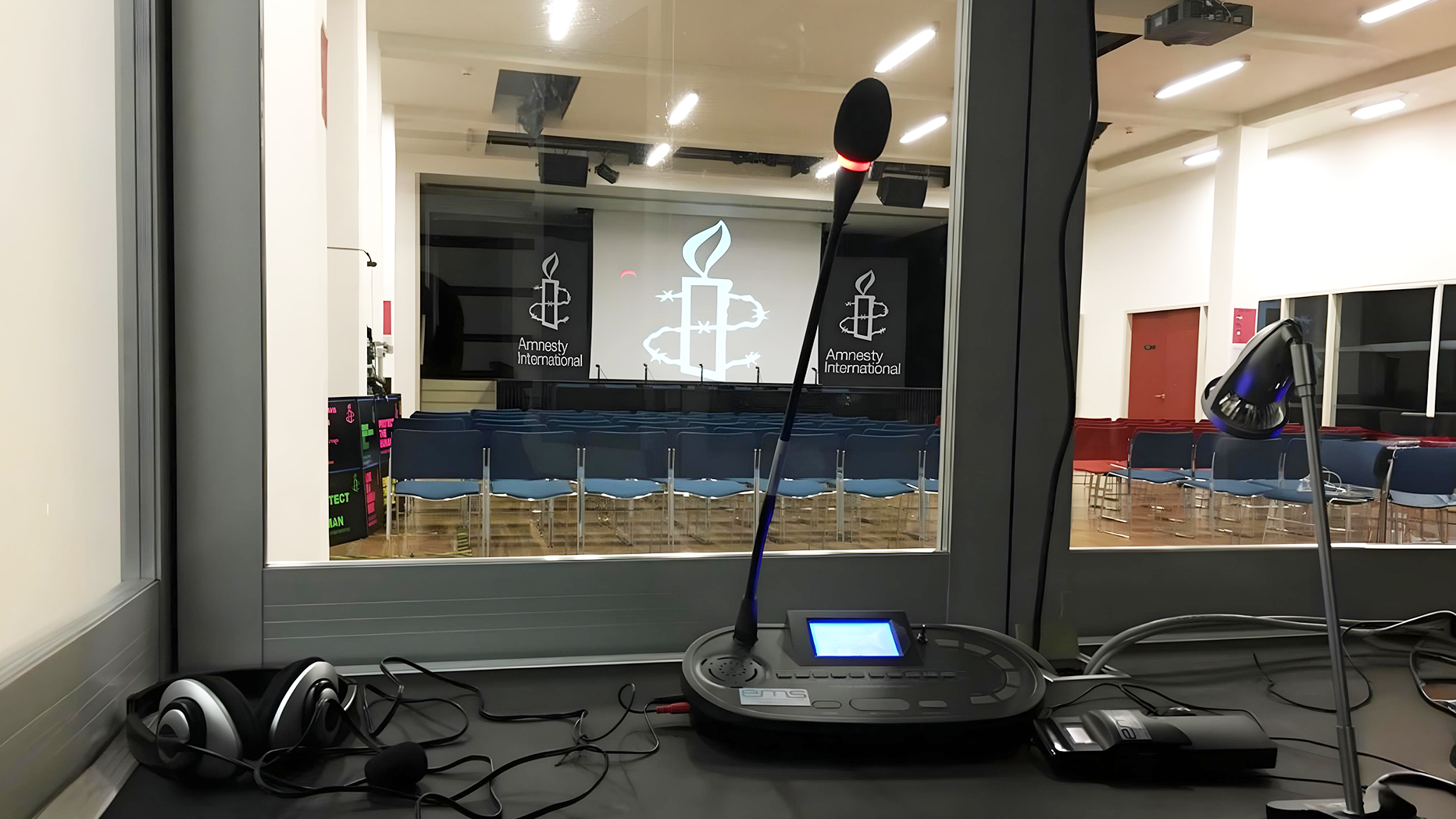
Interpreter booths are small soundproof spaces that keep interpreters focused. They block background noise and give interpreters the quiet they need to listen carefully and translate quickly.
There are two main types:
- Full-size booths: Best for large venues and multi-language setups.
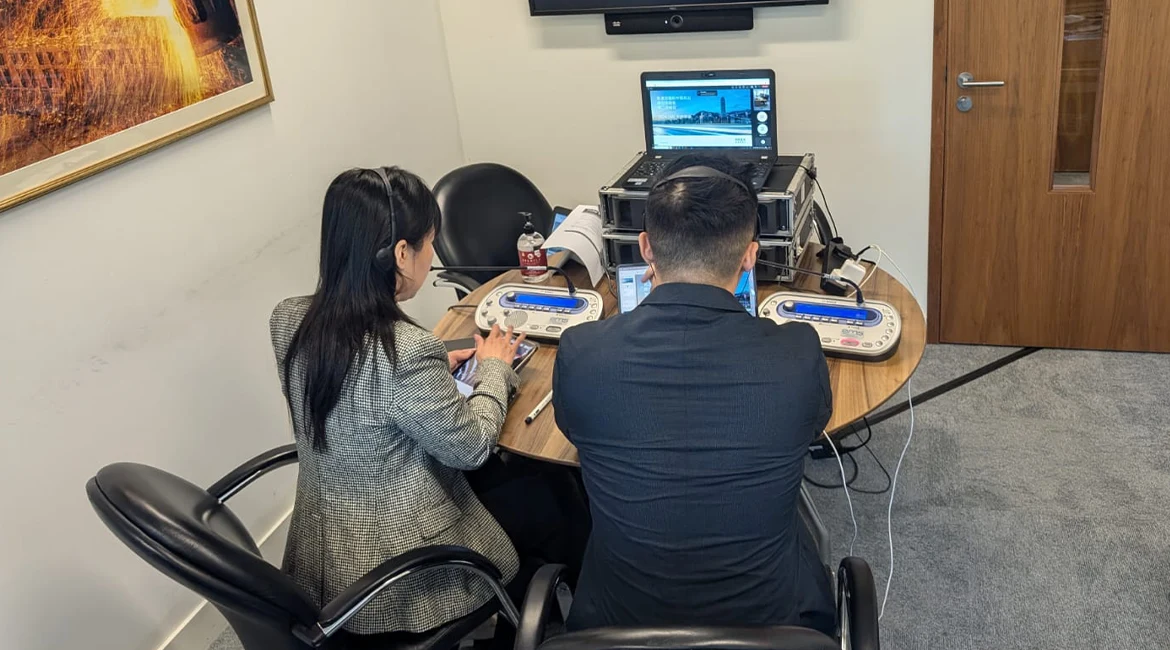
- Tabletop booths: Compact and portable, great for smaller events.
Choose booths that follow ISO standards for sound isolation, ventilation, and interpreters will thank you.
2. Interpreter consoles
The console is where interpreters control their work. It lets them:
- Adjust volume.
- Switch between language channels.
- Use relay mode (listen to another interpreter for translation reference).
High-quality consoles help interpreters keep rhythm and accuracy, especially when several languages are spoken at once.
3. Transmitters
Transmitters send the interpreter’s audio to the audience’s receivers. They must handle multiple channels at once, one per language.
Large events may need several transmitters placed across the hall to cover the distance without signal loss. Smaller rooms usually need one transmitter near the AV rack.
Modern RF transmitters give wider coverage, while IR transmitters work best indoors with a clear line of sight.
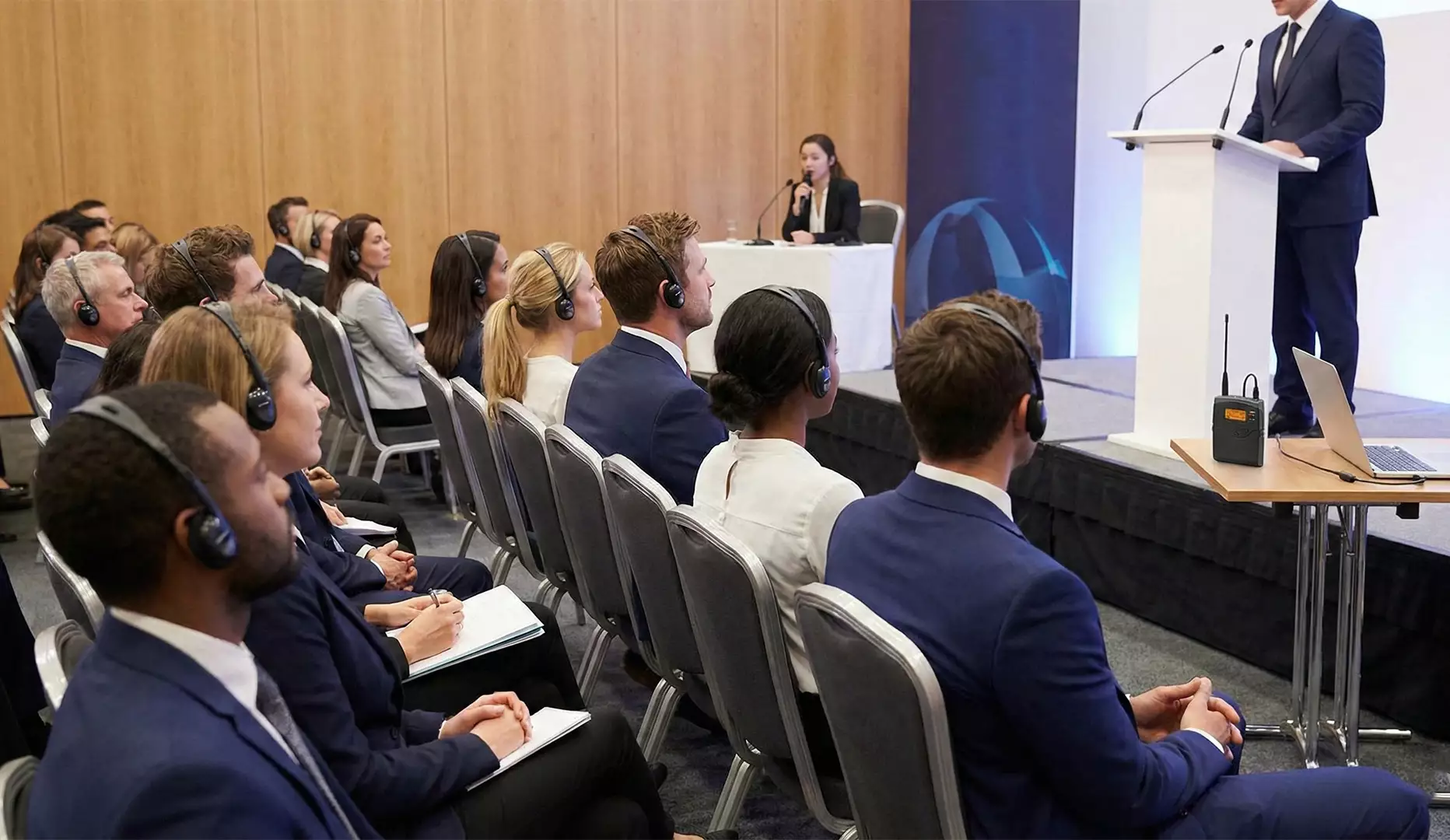
4. Receivers and headsets
Each attendee uses a receiver and headset to listen to the interpretation in their chosen language.
Look for receivers that are:
- Lightweight and comfortable.
- Multi-channel (so guests can switch between languages easily).
- Equipped with battery or signal indicators.
Headsets should be noise-cancelling, soft on the ears, and tested before the event. Cheap ones can create distortion, especially in long sessions.
5. Microphones
Quality microphones keep voices sharp and natural. Both speakers and interpreters rely on clean audio input; poor microphones mean poor translation.
Wireless mics allow movement on stage without cable clutter. For interpreters, fixed gooseneck microphones work best because they stay steady and consistent in distance.
6. Mixers and audio integration
All interpreting gear must connect smoothly to your AV system, including mixers, amplifiers, and speakers. This is how the interpreter’s audio feed reaches the audience.
A mismatch in setup can cause echo, feedback, or timing issues. That’s why integration testing before the event is crucial.
Choosing between infrared (IR) and radio frequency (RF) systems
Infrared (IR) works perfectly in conference rooms, hotels, or classrooms. It’s clean, secure, and easy to install.
Radio Frequency (RF) covers bigger spaces like exhibition centres or auditoriums, giving better range and stronger performance even when the room layout is complex.
| Feature | Infrared (IR) | Radio Frequency (RF) |
| Best for | Indoor or smaller venues | Large halls or outdoor events. |
| Signal range | Short, requires line of sight | Long-range, passes through walls. |
| Reliability | Can be affected by bright light | Stable even in complex environments. |
| Setup | Easy and compact | Needs planning and power coverage. |
| Cost | Usually lower | Slightly higher but more powerful. |
When planning, always consider your venue lighting, walls, and signal needs before choosing.
Match the equipment to your event
Not all events need the same setup. Here’s how to match your equipment to your conference type:
| Event Type | Recommended Setup |
| Small meetings (under 50 people) | 1–2 interpreters, IR system, tabletop booth, 1 channel. |
| Medium events (50–300 people) | 2–4 languages, RF system, full booths, backup transmitters. |
| Large conferences or exhibitions | Full RF network, multi-language console, on-site technicians. |
| Hybrid or online events | Remote interpreting software integrated with AV feed. |
Also consider the number of languages. Each language needs its own channel, interpreter, and sometimes an assistant technician for monitoring.
Remote and hybrid interpreting options
As more conferences become global and hybrid, Remote Simultaneous Interpretation (RSI) has become a powerful solution. Interpreters work from anywhere in real time, using digital tools to translate while viewers listen onsite or online.
Benefits of RSI
- Cuts travel and booth costs.
- Allows interpreters to join remotely.
- Works across different time zones.
- Offers backup flexibility if someone can’t attend.
To make RSI work smoothly:
- Use high-speed internet for all participants.
- Provide interpreters with quality microphones and headsets.
- Test the system on the same network used during the event.
- Choose secure platforms that integrate with Zoom, Microsoft Teams, or Webex.
AV Productions helps hybrid setups combine onsite interpreting gear with RSI platforms so every guest, remote or local, gets the same crystal-clear experience.
Budgeting smart: balancing cost and quality
Your interpreting system is like the heartbeat of your event; if it fails, everything stops. While it’s tempting to save money, cutting corners on quality can lead to poor sound and frustrated attendees.
What to include in your budget:
- Equipment hire or purchase.
- Set up and sound testing.
- On-site technical support.
- Backup units and spare batteries.
- Maintenance for longer events.
If your budget is tight, hybrid setups or portable IR systems can reduce costs while maintaining quality. The goal isn’t to buy the most expensive gear, it’s to buy or rent the most dependable one.
How to ensure technical compatibility
Your interpreting setup should work in harmony with your existing conference AV system. Before confirming your hire:
- Test how the system connects with your PA and mixing desk.
- Check that booth placement doesn’t block lighting or camera lines.
- Verify console settings match your transmitter model.
- Do a full rehearsal with interpreters and technicians present.
AV Productions’ engineers test and align all systems before the event, ensuring every signal, from the speaker’s mic to the listener’s headset, stays in sync.
Checklist: what to look for in a reliable provider?
- ISO-standard interpreter booths.
- RF and IR systems with backup transmitters.
- Multi-channel receivers and headsets.
- Experienced on-site technicians.
- Pre-event testing and rehearsals.
- Integration with hybrid event tools.
- 24/7 support during live sessions.
A professional AV team makes the difference between an event that’s good and one that’s seamless.
Why do event organisers choose AV productions?
AV Productions has supported multilingual events across the UK, delivering high-quality interpreting systems and full technical support. From corporate conferences and trade expos to government meetings, our team handles every detail with precision.
We Provide:
- Full-size and tabletop interpreter booths.
- RF and IR interpreting systems.
- Noise-cancelling receivers and headsets.
- On-site engineers for live monitoring.
- Remote interpreting setup for hybrid events.
Contact AV Productions today for a free consultation. Our experts will help you choose the best interpreting system and ensure your event runs smoothly from start to finish.
Closing Thoughts
Don’t let language barriers hold back your event. Choose AV Productions for professional conference interpreting equipment, hybrid event solutions, and end-to-end AV support across the UK. Let’s make your next conference fluent, inclusive, and flawless.
FAQs’
What’s the difference between simultaneous and consecutive interpreting?
Simultaneous interpreting happens in real time through headsets. Consecutive interpreting happens after each speaker finishes their part.
How many interpreters do I need per language?
For long sessions, you need two per language so they can take turns and stay focused.
Can I use interpreting systems for hybrid events?
Yes. AV Productions connects onsite and online systems for a seamless hybrid experience.
Which system works best for large spaces?
RF systems offer a stronger, wider signal and are best for large halls or outdoor events.
Do I need on-site technicians?
Yes. Trained technicians set up, monitor, and fix any sound issues immediately during the event.